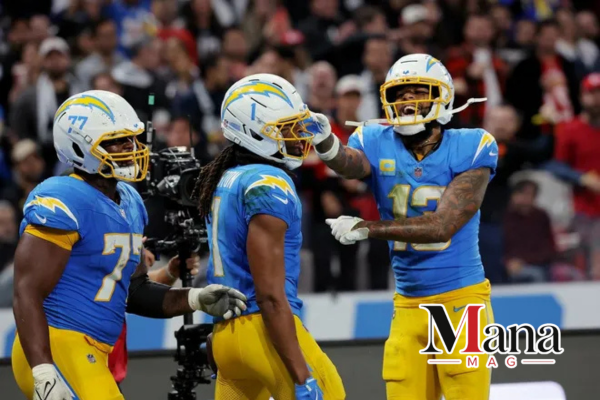
The Los Angeles Chargers defeated the Las Vegas Raiders 20-9 on September 15, 2025, at Allegiant Stadium. The Week 2 matchup featured a strong passing performance from Justin Herbert, two Chargers receiving touchdowns, and three interceptions thrown by Raiders quarterback Geno Smith.
The Chargers finished with 317 total yards compared with 218 for Las Vegas. Los Angeles also produced 236 passing yards and 81 rushing yards, while the Raiders managed 150 passing yards and 68 rushing yards.
For readers searching for Los Angeles Chargers vs Las Vegas Raiders match player stats or Las Vegas Raiders vs Chargers match player stats, this breakdown covers the main player numbers, scoring plays, team statistics, quarterback performances, rushing and receiving leaders, and the factors that decided the game.
Los Angeles Chargers vs Las Vegas Raiders Game Summary
The Chargers entered the matchup after opening the 2025 season with a win over the Kansas City Chiefs. Las Vegas also began the season with a victory, beating the New England Patriots in Week 1.
The Chargers maintained their perfect start with a 20-9 road win.
Final Score by Quarter
| Quarter | Los Angeles Chargers | Las Vegas Raiders |
| 1st | 10 | 3 |
| 2nd | 7 | 3 |
| 3rd | 3 | 0 |
| 4th | 0 | 3 |
| Final | 20 | 9 |
Los Angeles built a 17-6 halftime lead.
The Chargers opened the scoring with a 38-yard field goal from Cameron Dicker. Daniel Carlson answered with a 54-yard field goal for Las Vegas.
Justin Herbert then connected with Keenan Allen for a 10-yard touchdown.
The second quarter brought another field goal from Carlson before Herbert found Quentin Johnston for a 60-yard touchdown.
Dicker added a 20-yard field goal in the third quarter. Carlson’s 37-yard field goal in the fourth quarter completed the scoring.
Chargers vs Raiders Team Statistics
The final score tells only part of the story. The team numbers show that Los Angeles controlled the game through passing efficiency and fewer mistakes.
| Team Statistic | Chargers | Raiders |
| Total Net Yards | 317 | 218 |
| Passing Yards | 236 | 150 |
| Rushing Yards | 81 | 68 |
| Time of Possession | 28:17 | 31:43 |
| Penalties | 6 | 5 |
| Penalty Yards | 33 | 47 |
| Turnovers | 0 | 3 |
Las Vegas actually held the ball for more than 31 minutes, but possession time did not translate into points.
The biggest difference came through turnovers. Geno Smith threw three interceptions, while Justin Herbert did not throw one.
Justin Herbert Player Stats
Justin Herbert delivered the standout offensive performance for Los Angeles.
He completed 19 of 27 passes for 242 yards and two touchdowns. He did not throw an interception and finished with a passer rating of 122.8.
| Passing Statistic | Justin Herbert |
| Completions | 19 |
| Attempts | 27 |
| Completion Rate | 70.4% |
| Passing Yards | 242 |
| Touchdowns | 2 |
| Interceptions | 0 |
| Passer Rating | 122.8 |
| Longest Pass | 60 yards |
Herbert also rushed nine times for 31 yards.
His two touchdown passes were especially important because they came on explosive plays. He found Keenan Allen for a 10-yard score and Quentin Johnston for a 60-yard touchdown.
The 60-yard connection with Johnston was the longest offensive play in the game.
Herbert’s Passing Efficiency
Herbert averaged nearly nine yards per pass attempt.
He also avoided the turnover problems that hurt Las Vegas.
That combination gave Los Angeles a steady passing attack without requiring Herbert to throw a large number of passes.
Geno Smith Player Stats
Geno Smith had a difficult night against the Chargers defense.
He completed 24 of 43 passes for 180 yards. He did not throw a touchdown and was intercepted three times.
| Passing Statistic | Geno Smith |
| Completions | 24 |
| Attempts | 43 |
| Completion Rate | 55.8% |
| Passing Yards | 180 |
| Touchdowns | 0 |
| Interceptions | 3 |
| Longest Pass | 25 yards |
Smith also rushed five times for 20 yards.
The Raiders needed 43 pass attempts to produce 180 yards. The Chargers, by comparison, needed only 27 Herbert attempts to produce 242 yards.
That efficiency gap played a major role in the final result.
Chargers Rushing Stats
Los Angeles finished with 81 rushing yards.
Justin Herbert led the Chargers in rushing with 31 yards on nine attempts.
Najee Harris added 28 yards on eight carries, while Omarion Hampton rushed eight times for 24 yards.
Chargers Rushing Leaders
| Player | Carries | Yards | Average | Longest | TD |
| Justin Herbert | 9 | 31 | 3.4 | 12 | 0 |
| Najee Harris | 8 | 28 | 3.5 | 7 | 0 |
| Omarion Hampton | 8 | 24 | 3.0 | 15 | 0 |
| Quentin Johnston | 1 | -2 | -2.0 | -2 | 0 |
No Chargers running back scored a rushing touchdown.
Los Angeles instead relied on Herbert’s passing production and Cameron Dicker’s field goals.
Raiders Rushing Stats
Las Vegas produced 68 rushing yards.
Ashton Jeanty led the Raiders with 43 yards on 11 carries. Geno Smith added 20 yards on five rushing attempts.
Raiders Rushing Leaders
| Player | Carries | Yards | Average | Longest | TD |
| Ashton Jeanty | 11 | 43 | 3.9 | 13 | 0 |
| Geno Smith | 5 | 20 | 4.0 | 15 | 0 |
| Tre Tucker | 1 | 7 | 7.0 | 7 | 0 |
| Zamir White | 2 | -2 | -1.0 | 3 | 0 |
Jeanty was the Raiders’ leading rusher, but Las Vegas could not turn the running game into touchdowns.
That became more important as the Chargers built their lead.
Chargers Receiving Stats
The Chargers had several useful contributions in the passing game.
Quentin Johnston led Los Angeles in receiving yards with 71. Keenan Allen caught five passes for 61 yards and a touchdown. Ladd McConkey also caught five passes, finishing with 48 yards.
Chargers Receiving Leaders
| Player | Receptions | Yards | Average | Longest | TD |
| Quentin Johnston | 3 | 71 | 23.7 | 60 | 1 |
| Keenan Allen | 5 | 61 | 12.2 | 25 | 1 |
| Ladd McConkey | 5 | 48 | 9.6 | 19 | 0 |
| Tre’ Harris | 2 | 34 | 17.0 | 24 | 0 |
| Najee Harris | 2 | 20 | 10.0 | 11 | 0 |
| Will Dissly | 1 | 7 | 7.0 | 7 | 0 |
| Omarion Hampton | 1 | 1 | 1.0 | 1 | 0 |
Quentin Johnston’s 60-Yard Touchdown
Johnston’s 60-yard touchdown reception was the biggest passing play of the matchup.
He caught three passes for 71 yards.
One reception accounted for most of his total production, showing how one explosive play can change a close NFL game.
Raiders Receiving Stats
Jakobi Meyers led the Raiders with six receptions for 68 yards.
Brock Bowers caught five passes for 38 yards.
Neither player scored a touchdown.
Raiders Receiving Leaders
| Player | Receptions | Yards | Average | Longest | TD |
| Jakobi Meyers | 6 | 68 | 11.3 | 25 | 0 |
| Brock Bowers | 5 | 38 | 7.6 | 9 | 0 |
| Dont’e Thornton Jr. | 1 | 20 | 20.0 | 20 | 0 |
| Dylan Laube | 2 | 17 | 8.5 | 13 | 0 |
| Zamir White | 2 | 15 | 7.5 | 9 | 0 |
| Tre Tucker | 3 | 12 | 4.0 | 5 | 0 |
| Michael Mayer | 2 | 9 | 4.5 | 6 | 0 |
| Ashton Jeanty | 3 | 1 | 0.3 | 4 | 0 |
The Raiders moved the ball through short and medium completions but could not turn those drives into touchdowns.
Keenan Allen’s Touchdown
Keenan Allen gave the Chargers their first offensive touchdown.
Herbert found Allen for a 10-yard score late in the first quarter.
Allen finished the game with five catches for 61 yards.
His touchdown gave Los Angeles a 10-3 lead after Cameron Dicker’s extra point.
Cameron Dicker vs Daniel Carlson
Both kickers played an important role.
Cameron Dicker made three field goals for Los Angeles, including attempts from 38 and 20 yards.
Daniel Carlson made three field goals for Las Vegas, including a 54-yard kick.
| Kicker | Field Goals Made | Field Goals Attempted | Long |
| Cameron Dicker | 3 | 3 | 38 yards |
| Daniel Carlson | 3 | 3 | 54 yards |
The difference was touchdowns.
Los Angeles scored two touchdowns.
Las Vegas scored none.
As a result, three field goals were enough to give the Raiders only nine points, while the Chargers reached 20.
Why the Chargers Won
Several numbers explain the 20-9 result.
1. Los Angeles Won the Yardage Battle
The Chargers produced 317 total yards.
The Raiders finished with 218.
That is a 99-yard difference.
2. Herbert Was More Efficient
Herbert completed 19 of 27 attempts for 242 yards and two touchdowns.
Smith completed 24 of 43 attempts for 180 yards and no touchdowns.
Herbert threw fewer passes but gained 62 more passing yards.
3. Turnovers Hurt Las Vegas
Smith threw three interceptions.
Herbert threw none.
The Raiders had 43 pass attempts but failed to produce a touchdown through the air.
4. The Chargers Created Explosive Plays
Johnston’s 60-yard touchdown was the clearest example.
Los Angeles also produced several productive gains through Allen, McConkey, and other receivers.
5. Las Vegas Settled for Field Goals
The Raiders scored three field goals.
They never reached the end zone.
That limited their scoring ceiling even when they controlled the clock.
Time of Possession Was Not Enough
The Raiders held the ball for 31 minutes and 43 seconds.
The Chargers had possession for 28 minutes and 17 seconds.
That means Las Vegas controlled the clock for more than three additional minutes.
Still, the Raiders lost by 11 points.
This is a useful reminder when reading NFL box scores. More possession does not guarantee more points.
A team must turn drives into touchdowns and avoid turnovers.
Las Vegas struggled in both areas.
The Turnover Battle Was One-Sided
Turnovers were one of the clearest differences between the teams.
| Turnover Category | Chargers | Raiders |
| Interceptions Thrown | 0 | 3 |
| Total Turnovers | 0 | 3 |
Herbert protected the football.
Smith gave the Chargers three additional possessions through interceptions.
In a game where the Raiders already struggled to score touchdowns, losing possessions made the task even harder.
Chargers Defense Limited the Raiders
Las Vegas finished with only 218 total yards.
The Raiders produced 150 passing yards and 68 rushing yards.
Their longest completed pass was 25 yards, while the Chargers produced a 60-yard touchdown pass.
The Chargers defense also kept Las Vegas out of the end zone throughout the game.
That allowed Los Angeles to protect its lead without needing a huge offensive output in the second half.
First Half Set the Tone
The Chargers led 10-3 after the first quarter.
Los Angeles then added another touchdown in the second quarter.
The Raiders managed only one more field goal before halftime.
At the break, the score was 17-6.
The Chargers did not need a major offensive surge after halftime. Dicker’s third-quarter field goal increased the lead to 20-6, and Los Angeles held the Raiders to another field goal in the fourth quarter.
Key Player Matchups
Justin Herbert vs Geno Smith
Herbert clearly won the quarterback statistical battle.
He had:
- 242 passing yards
- 2 passing touchdowns
- 0 interceptions
- 122.8 passer rating
Smith had:
- 180 passing yards
- 0 passing touchdowns
- 3 interceptions
The difference was substantial.
Quentin Johnston vs Raiders Secondary
Johnston recorded only three catches, but one became a 60-yard touchdown.
He finished with 71 yards.
His 23.7 yards per catch led the Chargers’ main receiving group.
Jakobi Meyers vs Chargers Defense
Meyers led Las Vegas with six catches and 68 yards.
He provided the Raiders with a steady target, but the production did not result in a touchdown.
Ashton Jeanty vs Chargers Run Defense
Jeanty led the Raiders with 43 rushing yards.
He averaged 3.9 yards per carry.
The Raiders needed more production from their ground game, especially after Smith threw three interceptions.
What the Stats Say About Justin Herbert
Herbert’s numbers were efficient rather than volume-heavy.
He attempted 27 passes.
He completed 19.
He produced 242 yards and two touchdowns.
That works out to nearly nine yards per attempt.
He also avoided an interception.
The Chargers did not need Herbert to throw 40 or more passes because their offense generated enough yardage from fewer attempts.
That is one of the strongest statistical takeaways from this matchup.
What the Stats Say About Geno Smith
Smith’s 24 completions look respectable at first glance.
The larger picture is less favorable.
He attempted 43 passes for 180 yards.
He averaged only about 4.2 yards per attempt.
Three interceptions also erased several Raiders possessions.
His performance shows why completion totals alone can be misleading. A quarterback can complete many passes while still struggling to generate enough yardage or points.
What the Game Means for the Chargers
The 20-9 win moved Los Angeles to 2-0.
The Chargers had already beaten Kansas City in Week 1, so the victory over Las Vegas gave them another AFC win to begin the season.
The early-season numbers also showed a team capable of winning in different ways.
Against Las Vegas, Los Angeles relied on Herbert’s efficiency, explosive passing plays, field goals, and defensive pressure.
What the Game Means for the Raiders
Las Vegas dropped to 1-1 after the loss.
The Raiders had beaten New England in Week 1, so the Week 2 result evened their early record.
The biggest issue from the box score was turnover production.
Three interceptions from Smith and zero offensive touchdowns left very little room for error.
The Raiders did control possession and kept penalties relatively low, but those positives were not enough to overcome the passing and scoring gap.
Chargers vs Raiders Match Player Stats at a Glance
Here are the most important individual numbers from the game:
| Player | Team | Key Stats |
| Justin Herbert | Chargers | 19/27, 242 yards, 2 TD, 0 INT |
| Geno Smith | Raiders | 24/43, 180 yards, 0 TD, 3 INT |
| Quentin Johnston | Chargers | 3 receptions, 71 yards, 1 TD |
| Keenan Allen | Chargers | 5 receptions, 61 yards, 1 TD |
| Jakobi Meyers | Raiders | 6 receptions, 68 yards |
| Brock Bowers | Raiders | 5 receptions, 38 yards |
| Ashton Jeanty | Raiders | 11 carries, 43 yards |
| Najee Harris | Chargers | 8 carries, 28 yards |
| Justin Herbert | Chargers | 9 carries, 31 yards |
| Cameron Dicker | Chargers | 3 field goals made |
| Daniel Carlson | Raiders | 3 field goals made |
Final Takeaway
The Los Angeles Chargers beat the Las Vegas Raiders 20-9 in Week 2 of the 2025 NFL season.
Justin Herbert was the standout player. He completed 19 of 27 passes for 242 yards and two touchdowns without an interception. Quentin Johnston led the Chargers in receiving yards with 71, including a 60-yard touchdown. Keenan Allen added five catches, 61 yards, and a touchdown.
For Las Vegas, Jakobi Meyers led the receiving group with 68 yards, while Ashton Jeanty rushed for 43 yards. Geno Smith completed 24 passes for 180 yards but threw three interceptions and failed to record a touchdown.
The final numbers show why the Chargers won.
Los Angeles gained 317 total yards compared with 218 for Las Vegas. The Chargers scored two touchdowns, while the Raiders relied entirely on field goals. The turnover battle was also heavily tilted toward Los Angeles.
The most useful statistic for this matchup is not one individual number. It is the combination of Herbert’s 242 passing yards, two touchdowns, zero interceptions, and the Raiders’ three turnovers.
That combination turned a relatively competitive game into a clear Chargers victory.
For anyone checking Los Angeles Chargers vs Las Vegas Raiders match player stats or Las Vegas Raiders vs Chargers match player stats, the box score points to one simple difference: Los Angeles converted its opportunities into touchdowns, while Las Vegas struggled to finish drives.
FAQ: Los Angeles Chargers vs Las Vegas Raiders Match Player Stats
Who won the Chargers vs Raiders game in September 2025?
The Los Angeles Chargers defeated the Las Vegas Raiders 20-9 on September 15, 2025, at Allegiant Stadium.
What were Justin Herbert’s stats against the Raiders?
Justin Herbert completed 19 of 27 passes for 242 yards and two touchdowns. He threw no interceptions and finished with a 122.8 passer rating. He also rushed nine times for 31 yards.
What were Geno Smith’s stats against the Chargers?
Geno Smith completed 24 of 43 passes for 180 yards. He threw no touchdowns and three interceptions. He also rushed five times for 20 yards.
Who led the Chargers in receiving?
Quentin Johnston led the Chargers with 71 receiving yards on three catches. He also scored a 60-yard touchdown.
Who led the Raiders in receiving?
Jakobi Meyers led the Raiders with six receptions for 68 yards. Brock Bowers finished second among Raiders receivers with five catches for 38 yards.
Who led the Chargers in rushing?
Justin Herbert led the Chargers with 31 rushing yards on nine carries. Najee Harris had 28 yards, while Omarion Hampton recorded 24 yards.
Who led the Raiders in rushing?
Ashton Jeanty led Las Vegas with 43 rushing yards on 11 carries. Geno Smith added 20 rushing yards.
How many interceptions did Geno Smith throw?
Geno Smith threw three interceptions against the Chargers. Justin Herbert threw zero interceptions.
How many touchdowns did the Raiders score?
The Raiders did not score a touchdown. They scored three field goals, finishing with nine points.
How many touchdowns did the Chargers score?
The Chargers scored two touchdowns, both through the air. Justin Herbert threw touchdown passes to Keenan Allen and Quentin Johnston.
Which team had more total yards?
The Chargers had 317 total yards, while the Raiders finished with 218. Los Angeles held a 99-yard advantage in total offense.
Which team had more possession time?
The Raiders had more possession time at 31:43. The Chargers had the ball for 28:17.
What was the longest play of the game?
The longest play was Justin Herbert’s 60-yard touchdown pass to Quentin Johnston in the second quarter.

Must See
-

Sports
/ 2 weeks agoLos Angeles Chargers vs Detroit Lions Match Player Stats: 2025 Hall of Fame Game
The Los Angeles Chargers defeated the Detroit Lions 34-7 in the 2025 NFL Hall...
By Mica -


Sports
/ 2 weeks agoPittsburgh Pirates vs Mets Match Player Stats: August 2026 Game Breakdown
The Pittsburgh Pirates and New York Mets produced two very different games during their...
By Mica -


Sports
/ 2 weeks agoGolden State Warriors vs Orlando Magic Match Player Stats, Box Score and Game Analysis
The Golden State Warriors beat the Orlando Magic 120-97 on December 22, 2025, at...
By Mica